The promise was that AI agents would make building software easier. The reality is that they hand you the cognitive load of an entire team — and most people are carrying it alone.
This isn't a complaint about the tools. The tools are genuinely good. VS Code, Cursor, Claude Code, and the rest have shipped the engine, the drivetrain, the suspension — powerful parts, delivered to your driveway in boxes. But right now every team is assembling their own car in the garage, and most of the cognitive load isn't in deciding where to drive. It's in making sure the wheels stay on at seventy. modulaa assembles the car. The agents, the prompts, the handoffs between analysis, approval, and build — that's the process we encoded into the platform. It's ready when you are. Your cognitive load stays where it belongs: on the software you're shipping, not on the machinery underneath it.
Seven steps forward, five steps back
Working with AI coding agents feels a lot like seven steps forward, five steps backward. Then sometimes it’s ten steps forward, one step back. The pendulum swings. You keep moving — typically you move forward quite a bit — but the regressions are real, and controlling the regressions is where the cognitive load lives.
It takes a lot of know-how. Not just writing code, but orchestrating agents: managing the context they see, the tools they’re allowed to call, and the recovery path when a session drifts from the last known-good state. Because they do go sideways, quickly, and the further you are from that state the more expensive the recovery.
For most teams we talk to, that’s a senior engineer’s week — every sprint — spent not shipping, just keeping the agent on the rails. Best practices exist, and they shift weekly. But the load doesn’t come from any single tool — it comes from assembling them into a process you can rely on.
Going back to first principles
So at modulaa we went back to the beginning — first principles — and asked: what is it actually like to create software in this new paradigm of agents?
This is where we’ve landed. The shape has stabilized enough to share.
Information comes in. You have to synthesize it — from noise to signal. That signal then needs to be dispersed among the team, because the team has to buy in and use their expertise to confirm the results are actually true and actually meet the company’s goals. Once there’s consensus on the direction and the plan, you build — against the approved scope: the files, the plan, and the acceptance criteria the team signed off on — and eventually deploy or open a merge request.
Three activities: analyze, visualize, build. That’s the core of agentic software development.
The hard part isn’t any one of those — it’s encoding the handoffs between them so a team can rely on the result. That’s the part nobody has packaged well yet, and it’s what we’ve spent the last few months building.
The three workspaces
We turned those three activities into three workspaces. Each project in modulaa has a project diagram at its core, and at its core that diagram currently has three nodes:
- Synthesizes input from data sources
- Team reviews and confirms
- Agreement on direction
- Builds from approved file
- Deploy or merge back
- Analyzer — synthesizes input from your data sources, turning noise into signal. Today it ingests your repository, issue tracker, and existing documentation, and emits a structured signal: a prioritized set of change targets, each with the evidence it was ranked on (referenced files, issue links, related history) and a confidence score the team can audit before approving. You stop guessing what to work on next.
- Visualizer — brings those results to the surface so the team can review, confirm, and reach consensus on the direction and the plan. This is the human-in-the-loop gate. Your team signs off before a line of code is written.
- Builder — takes the approved context and builds the software, eventually deploying or opening a merge request against your codebase, with the diff scoped to the approved file set (out-of-scope changes are rejected before merge) and a test gate that runs your existing suite against the scoped diff — so the regression surface is bounded by what was approved, not by what the agent decided to touch. You ship without the seven-steps-back.
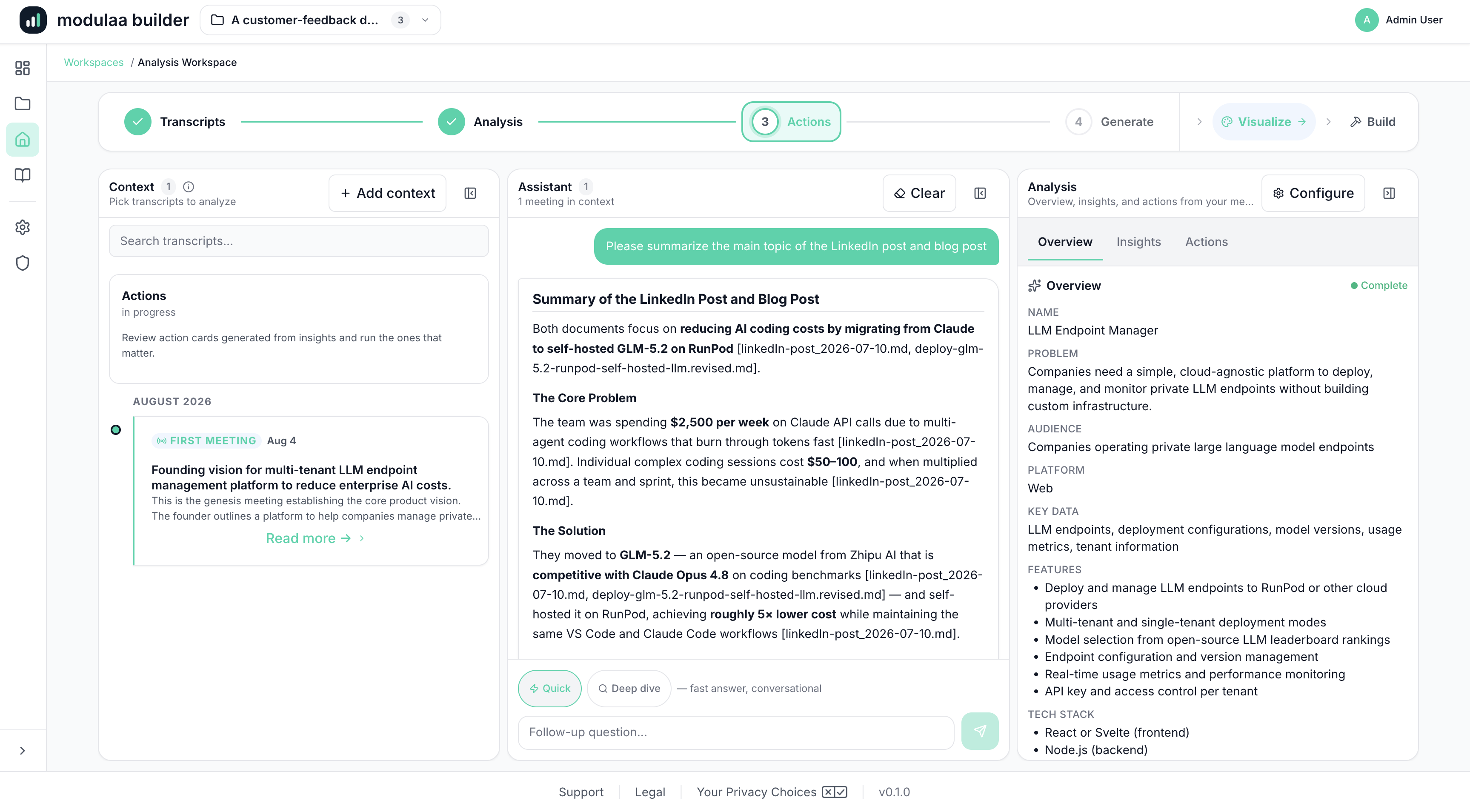
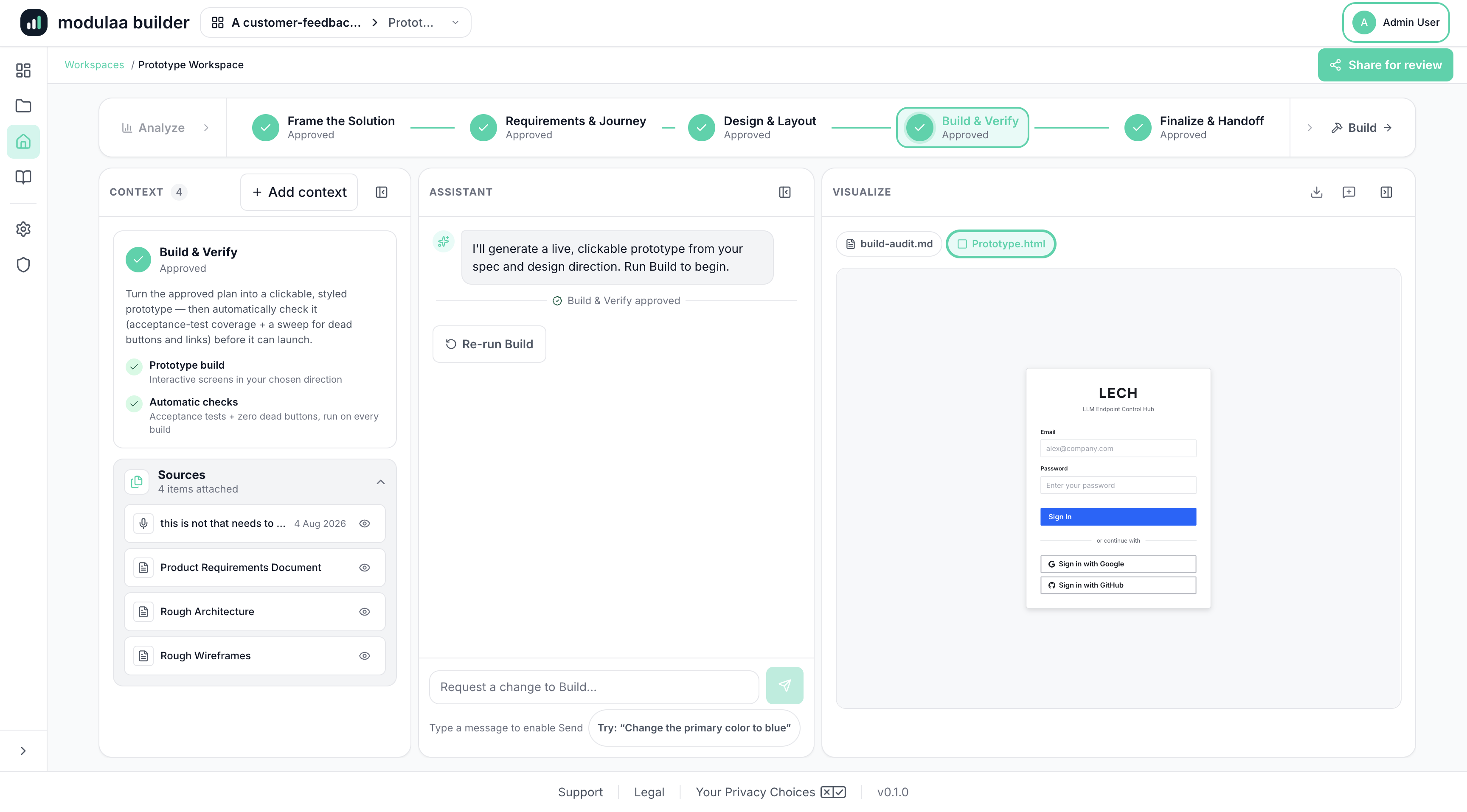
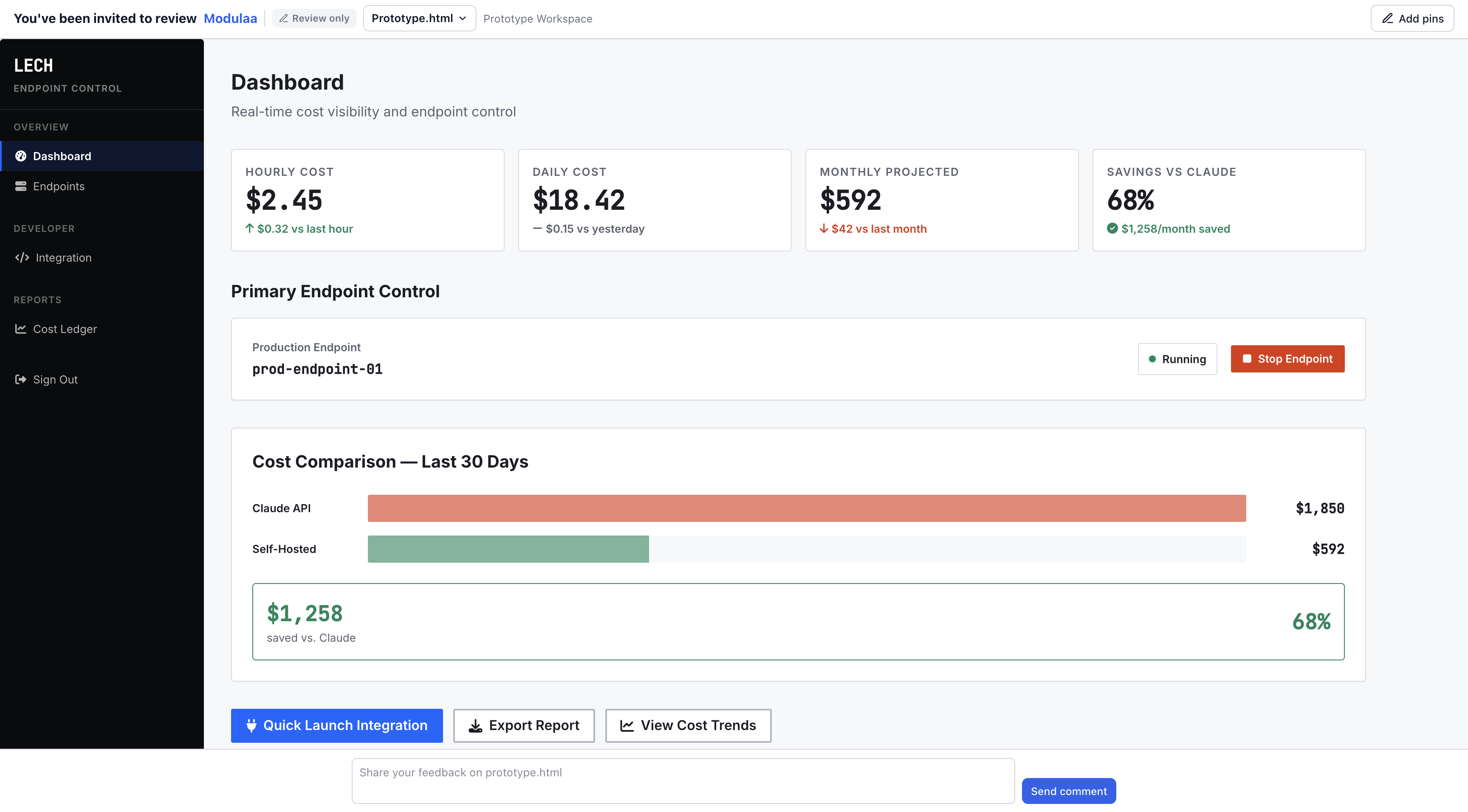
The diagram doesn’t stop at three nodes. Real projects run several analyzers into one visualizer, or an analyzer on its own — the node map extends as far as your process does. The diagram is a persisted, versioned graph — each node carries its inputs, its emitted artifacts, and the approval that unlocked the next node, so the full decision history of a project is replayable, not just the final code. That history is the asset: every approved and rejected plan becomes the signal the next analyzer ranks against.
On the roadmap: compliance, leadership, and security workspaces linked into that same node map — the same analyzer → visualizer → builder shape, applied to the rest of the process. The node-map model is built to extend.
The car, and what it meant
A lot of smart people have built great tools for working with agents. The clearest analogy: people built a car. There’s this great machinery of a car, and everyone’s excited.
But the higher level is what does that mean? For the people who first drove one, the car meant a kind of freedom they hadn’t named yet — the freedom to move on their own terms.
We think the tools are doing the same thing for code: an amazing acceleration in creating software. But the cognitive overload that comes from assembling that acceleration into something you can rely on is real. Packaging it into a process is what turns acceleration into empowerment.
You wouldn’t get very far if, every time you wanted to drive, you had to know exactly how to connect the tire to the axle. The car works because all of that is packaged together and all you have to do is get in and drive. We packaged the tire-to-axle work — the handoffs, the approval records, the scoped diffs — so you get in and drive.
From noise to signal — and why that’s our icon
This is the whole reason modulaa exists: take the noise, increase the signal. It’s why our icon is three bars that look like a cell-phone signal — the stronger it gets, the more bars you have.

From noise to signal. The end goal of the process is empowerment: you still need technical judgment — what to approve, what to reject, when to override the agent. What you don’t need is to carry the entire team’s context in your head. The platform holds the plan, the consensus, and the approved context, so the cognitive load is distributed across the workspaces instead of concentrated in one person.
Where modulaa comes in
We built this for ourselves first — it powers modulaa's own platform and our consulting engagements. We're not just writing about it; we run it every day.
For engineering leaders, the cost isn’t the agent — it’s the senior engineer whose week disappears orchestrating it. modulaa is built to return that week: the platform holds the plan, the consensus, and the scope, so the senior engineer reviews instead of orchestrates. Teams running the analyzer → visualizer → builder flow ship with a reviewable plan at every step, instead of a single person holding the whole process in their head.
If you want the acceleration without the cognitive load of assembling it yourself, that’s exactly what we do with our clients:
- [Agentic Consulting](/how-it-works) — We run the analyzer → visualizer → builder process with your team on a real project. Best first step: you see the process on your codebase in weeks, not quarters. Talk to our team →
- [Agentic SDLC Tool](/how-it-works) — Your team runs the same process on our platform, with human approval at every consensus step. Best when you’ve seen the process work and want to scale it across projects. See the platform →
Every consensus step produces a labeled record of what your team approved and rejected — approved plans become positive examples, rejected plans become negative examples, and the analyzer’s ranking improves with every project your team runs. That’s the flywheel: more projects, more labeled signal, a sharper analyzer the next time. It’s also the moat — the platform gets sharper with every project run on it, and that data doesn’t exist outside modulaa.
We succeed when you succeed. That’s the partnership model — not a vendor relationship. Your senior engineers get to focus on the 20% of work that actually requires them, and we empower the rest.
What’s next
This is the first in a series on the process layer for agentic software development — how we take these tools and make them less cognitively dependent on you, and free you up to create.
If you want the technical underpinning of how we run the agents behind this process, our previous post walks through self-hosting GLM-5.2 on RunPod — the model and infrastructure that powers the builder workspace. And if you want the broader argument for why organizational absorption is the real limiter, our speed-limit series goes deeper.
Want to see the analyzer → visualizer → builder flow on your own repo? Book a 30-min walkthrough.
For engineering leaders: if your senior engineer’s week disappears orchestrating agents every sprint, talk to our team about running the analyzer → visualizer → builder flow with your team — or book a 30-min discovery call. We’ll map the flow to one of your real projects so you can see the regression surface shrink before you commit to anything.
For investors: if you see the same thesis — that packaging the machinery is the real opportunity in agentic software development, not the agent — the founders read every email: scott.markley@modulaa.ai · mo.hamzah@modulaa.ai. If you want the numbers behind the thesis — cost per merged PR, regression rate, and the size of the labeled-decision corpus — we’ll share them under NDA.